Good organization makes things easier to find, use, and put away. The goal is not a home full of matching containers. It is a system you can keep using.
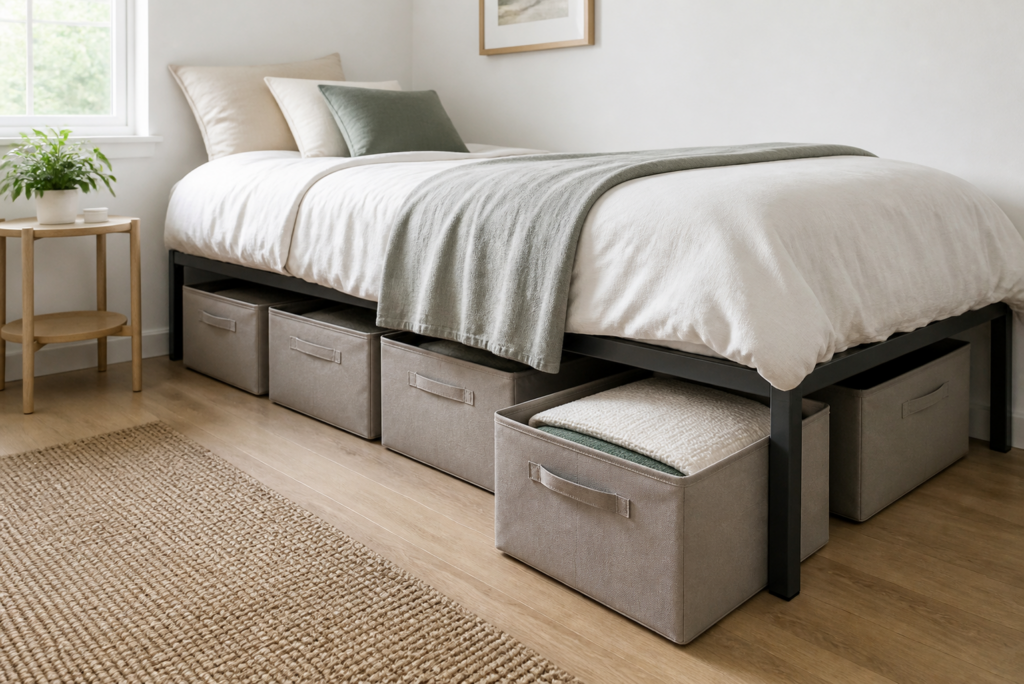
Make overlooked space useful
Hidden away. Easy to reach.
Under-bed storage can suit extra linens and seasonal clothes. It is less useful if you have to move several pieces of furniture every time you need something.
Compare under-bed storage →AI-generated illustration, not a photograph of the recommended products.
Organize one small zone
- Choose a boundary. Start with one drawer, shelf, or under-bed section. Avoid emptying the entire room at once.
- Group by use. Keep items used together in the same place. Put daily essentials where you can reach them without moving other things.
- Decide what belongs. Relocate items used in another room. Set aside anything you no longer want before measuring for containers.
- Measure the contents and the space. A container has to fit both. Include handles, lids, and the room required to pull it out.
- Test the return step. Can you put an item away with one straightforward action? If the process is fiddly, simplify it.
Try the fit check before buying.
Compare a container’s outside dimensions with the unobstructed space under your bed. The tool checks height and both footprint orientations; you still need to check pull-out access.
Open the storage fit check →Open baskets or closed containers?
Open storage makes frequently used items easy to grab. Closed storage keeps visual clutter out of view and may offer protection depending on its construction. Choose around the contents and location rather than using the same type everywhere.
How do I stop the clutter coming back?
Leave some free capacity and give incoming items a specific home. During a short weekly reset, notice which items repeatedly land elsewhere—that is a clue the assigned location may be inconvenient.