PRACTICAL ROOM GUIDE
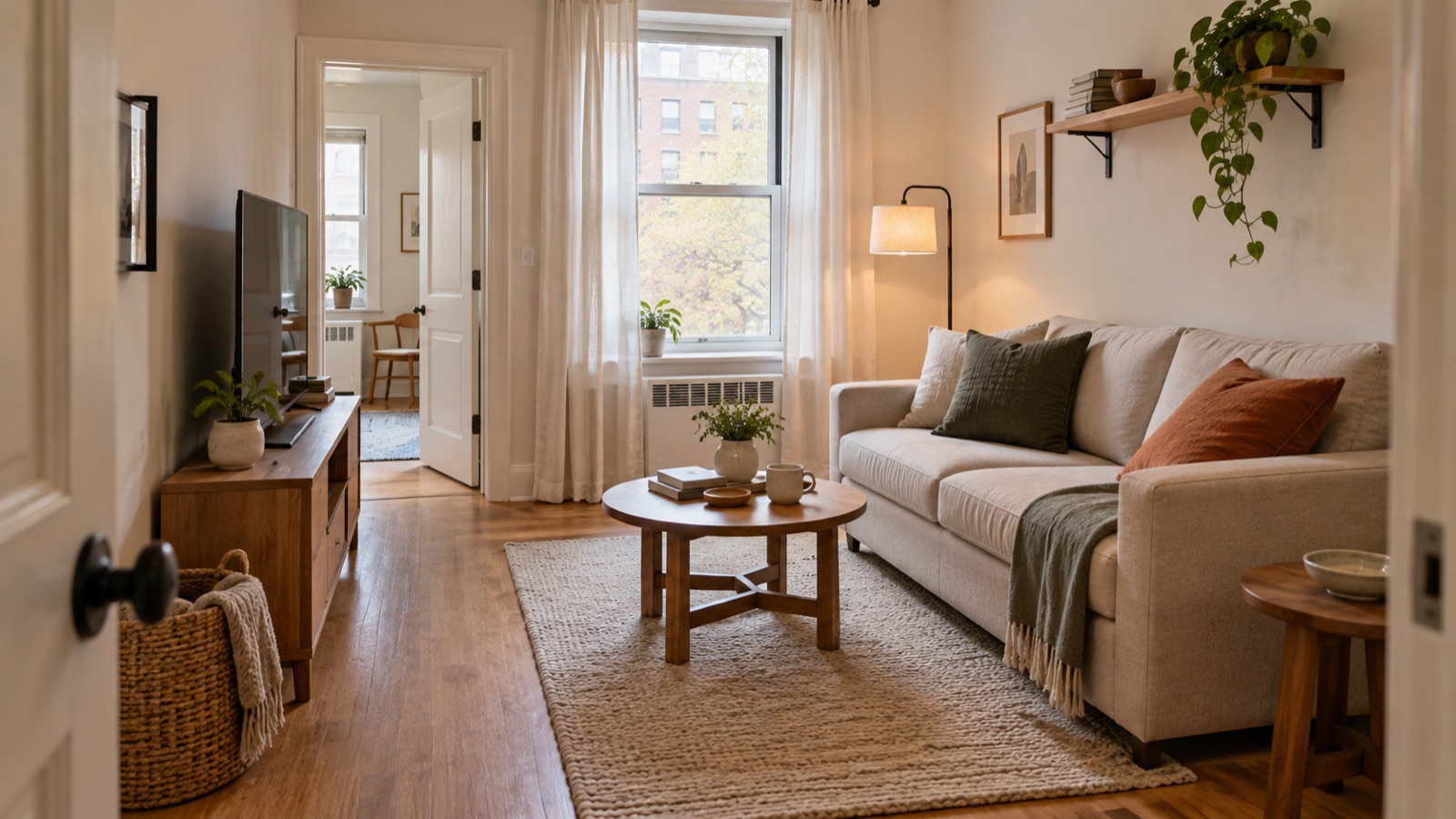
A small living room works best when the layout supports what actually happens there. Before adding another table, basket, or chair, decide how people need to move through the room, where they sit, and which activities require a surface, light, or storage. The goal is not to make the room look empty. It is to make every piece easier to use.
Map the room before moving furniture
Measure the walls, doorways, windows, radiators, outlets, and any route that connects this room to another part of the home. Record the actual furniture dimensions as well. A sofa can fit along a wall and still be wrong for the room if its arms block a doorway or its depth leaves too little space in front.
- Mark door swings and fixed obstacles.
- Keep the main route through the room continuous.
- Check that cabinets and drawers can open fully.
- Test proposed furniture footprints with removable tape before buying.
1. Establish the walking path first
Start with the route between doors and the places people use most often. Do not force the path through the middle of a seating group if the room can be arranged so movement happens along one side. A clear route makes the room feel easier to use and reduces the chance that bags, stools, or table corners become daily obstacles.
What to check: walk the full route, open every nearby door, and carry a laundry basket or shopping bag through it. A path that works only when your hands are empty is not fully practical.
2. Choose sofa scale before sofa style
The outside width is only one measurement. Sofa depth, arm width, back height, and the space needed to deliver it all affect whether it suits a compact room. A shallower sofa with narrower arms can preserve useful floor space without reducing the number of seats.
Measure the intended position as well as the delivery route through building entrances, stairways, hallways, and door frames. If the room must support occasional guests, compare a compact sleeper or modular option with the space required when it is fully opened.
3. Match the coffee table to the movement pattern
A coffee table should provide a useful surface without turning the seating area into an obstacle course. Round and oval tables remove sharp corners from tight routes, while nesting tables can separate when needed and tuck together afterward. In some rooms, a small side table beside the sofa is more useful than a large table in the center.
Measure the available space with people seated and consider how they stand up and pass through. Choose a stable design and avoid relying on a lightweight stool or basket as a table if it is not intended for that purpose.
4. Use a rug to define the seating zone
A rug can visually connect the sofa, chair, and table, especially in an open-plan apartment. It does not need to fill the whole room, but it should relate clearly to the seating rather than floating as a small island in the center.
Measure around floor vents, door clearance, and furniture legs. Use an appropriate non-slip solution where needed, keep edges flat, and choose a material you can maintain in the household’s actual conditions.
5. Move selected storage upward
A narrow bookcase, wall shelf, or tall closed cabinet can store more than another low piece spread across the floor. Keep frequently used items at comfortable reach and reserve higher positions for lighter, occasional belongings. Closed storage is useful for cables, paperwork, games, and other categories that make the room look busy.
Check the wall type, baseboards, switches, and any need for anti-tip securing. Follow the product and hardware instructions, and confirm what your rental agreement permits before drilling.
6. Place lighting where activities happen
One ceiling light often leaves a small room feeling flat and makes reading or detailed tasks uncomfortable. Add light where it has a job: beside the sofa for reading, near a desk for work, or directed toward a wall for softer evening illumination. A slim floor lamp can add useful light without requiring another table.
Keep cords out of walking paths, do not overload outlets, and use bulbs and fixtures according to their ratings. Renters can prioritize plug-in lighting that moves with them.
7. Add one flexible piece instead of several extras
A lightweight side table, nesting-table set, storage ottoman, or compact stool can support different activities without permanently occupying a second zone. Choose the piece for a defined job and make sure it has a normal parking place when it is not in use.
Multifunctional furniture is useful only when each function is genuinely convenient. Test lid clearance, weight, stability, and how often the item will need to move. A complicated piece that stays closed or blocks another cabinet does not save practical space.
A simple order for arranging the room
- Map the main walking route and fixed obstacles.
- Position the largest necessary piece, usually the sofa.
- Place lighting and the most useful surface.
- Add storage for specific categories.
- Live with the layout before filling every open corner.
A successful small living room does not depend on a perfect furniture set. It comes from a clear route, correctly scaled pieces, and storage positioned around everyday routines.